

Hikvision ColorVu Complete Guide 2026: Cameras, Lens Choice, Bandwidth & Site Selection


Published 11 May 2026 · UK installer hub guide · Author: Netview
Hikvision ColorVu has moved from a single low-light camera line into a fully-fledged technology family that now spans IP, Turbo HD, HiLook AoC, panoramic, PTZ and solar 4G. If you are specifying a CCTV system in 2026, the question is no longer "ColorVu or IR" — it is which generation of ColorVu, which lens, which supplemental-light mode and which NVR. This complete UK installer guide pulls the current Hikvision ColorVu range, the technology behind it, the bandwidth implications and the on-site decisions into one reference page. Phone 01163 800 838 if you want to talk a spec through with a wholesaler before placing the order.
At a glance
- What ColorVu does: delivers 24/7 full-colour video by pairing an F1.0 aperture lens with a large sensor and a warm-light supplemental LED.
- Current generation: ColorVu 3.0 with HikAI-ISP, launched with EasyIP 4.0 Plus in October 2024. Up to 130% better light sensitivity than ColorVu 2.0 and a new Super Confocal F1.0 lens that focuses visible and IR light onto the same plane.
- Lens picks: 2.8mm for porches, driveways and 4-6 m identification ranges; 4mm for long drives and gate approaches; motorised 2.8-12mm where the site brief is still moving.
- Bandwidth budget: assume 2 Mbps for 4MP H.265+ and 4 Mbps for 8MP H.265+ at the recommended bitrate, and double both at night — ColorVu pulls more bits in low light because the scene is noisier.
- Where it earns its keep: dark forecourts, commercial yards, retail entrances, ANPR identification lanes, hospitality car parks. Where it does not: very dark interiors with no supplemental light, or perimeter zones where covert IR is mandatory.
What is Hikvision ColorVu?
ColorVu is Hikvision's brand name for 24/7 full-colour CCTV. Instead of switching to monochrome infrared at night, a ColorVu camera holds onto colour by combining three things: a large-aperture lens (F1.0 on every current ColorVu generation), a back-illuminated sensor tuned for low-light sensitivity, and a low-temperature warm supplemental LED that fires when ambient light drops below a configurable threshold. The result is recognisable people, readable plates and the same colour cues — red coat, blue car, green high-vis — that you would see in daylight.
According to Hikvision UK's ColorVu technology page, the lineage now covers four product lines: Pro Series ColorVu network cameras (the current EasyIP 4.0 Plus with ColorVu 3.0), Value Series ColorVu, HiLook IP ColorVu and Turbo HD ColorVu. All four share the same F1.0 lens principle. What separates them is sensor size, ISP processor, warm-light intelligence and feature set (AcuSense, Audio 2.0, Motorization 2.0).
ColorVu generations: from F1.6 to ColorVu 3.0 with HikAI-ISP
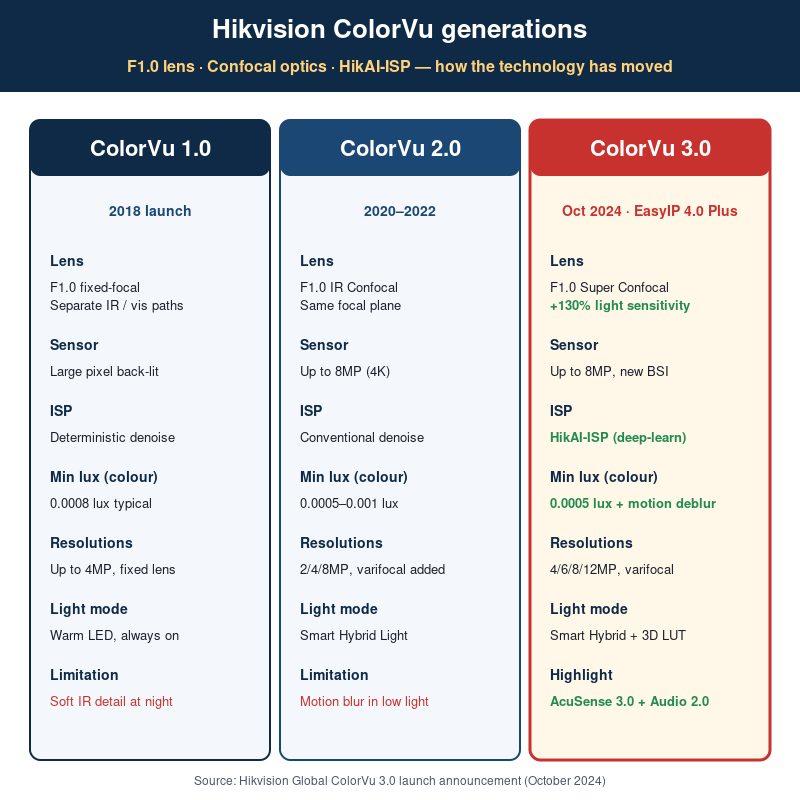
ColorVu 1.0 launched in 2018 with a fixed-focal F1.0 lens but a separate light path for visible and infrared light — fine in colour but soft on detail because the two paths could not focus on the same plane. ColorVu 2.0 (2020-2022) replaced that with an F1.0 IR confocal lens that pulled both into the same focal point, fixing the night-time soft-focus problem and introducing 4K and varifocal options. ColorVu 3.0 (October 2024, EasyIP 4.0 Plus) is a larger step: an enhanced F1.0 Super Confocal lens with up to 130% better light sensitivity than ColorVu 2.0, a HikAI-ISP image processor that applies deep-learning denoising and motion deblur in real time, and 3D LUT colour correction. Source: Hikvision PR Newswire — ColorVu 3.0 launch.
HikAI-ISP is the headline change. The previous generations applied a deterministic denoising chain; on a ColorVu 3.0 camera the chip carries a deep-learning model trained on millions of low-light scenes that restores moving objects without smearing them. Coupled with the Super Confocal lens, the practical outcome at 0.0005 lux is sharper plates and crisper faces — exactly the test conditions where ColorVu 2.0 occasionally lost detail to motion blur or noise grain.
The F1.0 Super Confocal lens: why aperture is the heart of ColorVu
An F1.0 lens admits roughly 2× the light of an F1.6 lens at the same focal length, which is why ColorVu cameras can hold colour where a conventional camera has already switched to IR. The Super Confocal upgrade in ColorVu 3.0 also corrects for the wavelength shift between visible light (380-700 nm) and near-infrared (around 850 nm) so that both share a single focal plane. In practice this matters because ColorVu cameras still fall back to IR in black mode when the scene is genuinely lightless — and if the lens cannot focus IR and visible light on the same plane, every mode switch costs sharpness.
For varifocal ColorVu cameras like the DS-2CD2747G2HT-LIZS 4MP Smart Hybrid ColorVu motorised dome, Hikvision holds the F1.0 aperture across the full 2.8-12mm zoom range. That is unusual — most varifocal cameras step down to F1.6 or F2.0 at the long end. The lens cost is the reason ColorVu varifocal SKUs sit at the top of the price band.
Smart Hybrid Light: how warm LED, IR and AcuSense work together
Smart Hybrid Light is the supplemental-light mode that the LSYE, LSU, LXTS, LUF and PIRXO suffix groups share. The camera runs three modes side-by-side: warm-light (ColorVu) for ambient-detected low-light, infrared (black mode) for true darkness, and event-triggered hybrid — the warm light only ramps to full brightness when AcuSense classifies a person or vehicle in the scene. The hybrid mode is the right default for installer-fit residential work because it avoids the "white light always on" objection from neighbours and the customer's electricity bill. Hikvision's 2023 Smart Hybrid Light launch note confirms the warm LED only fires on classified detection, then steps back to IR when the target leaves.
ColorVu IP camera range on Netview UK shelves
This is the live in-stock IP ColorVu range as of May 2026. All ship same-day from our Leicester warehouse when ordered before 16:30. The table groups by sensor resolution and lens.
| Model | Resolution | Lens / FOV | Form factor | Light tech | Notes |
|---|---|---|---|---|---|
| IPC-T229HA-LU | 2MP | 2.8mm / 106° | HiLook turret | Smart Hybrid | Best-value Smart Hybrid IP turret; built-in mic |
| IPC-T249HA-LU | 4MP | 2.8mm / 96° | HiLook turret | Smart Hybrid | The Netview default for residential Hilook installs |
| IPC-T280HA-LUF/SL | 8MP (4K) | 2.8mm / 113° | HiLook turret | Smart Hybrid + Strobe | LiveGuard strobe + speaker on event; great for forecourts |
| IPC-T280HAD-LUF/SL | 8MP (4K) | 2mm 180° pano | HiLook panoramic | Smart Hybrid | Single-pole 180° coverage — saves two cameras per gable |
| DS-2CD2747G2HT-LIZS | 4MP | 2.8-12mm motorised | Pro dome | Smart Hybrid + AcuSense | Where the brief moves — site re-tunes the lens from the NVR |
| DS-2CD2387G2P-LSU/SL | 8MP (4K) | 2.8mm dual / 180° | Pro panoramic turret | ColorVu + Strobe | True dual-sensor 180° — two 4MP panes stitched |
| DS-2CD2T87G2P-LSU/SL | 8MP (4K) | 2.8mm dual / 180° | Pro panoramic bullet | ColorVu + Strobe | Bullet variant of the 2387G2P — eaves-mounted forecourts |
ColorVu Turbo HD and HiLook AoC: ColorVu for coax sites
Not every site can be re-cabled to Cat6. ColorVu is fully supported on Turbo HD coax (HD-TVI), and the HiLook AoC (Audio over Coax) line carries audio on the same single coax run. The AoC turrets — THC-T229-MS (2MP), THC-T259-MS (3K) and THC-T159-MS (3K with audio) — are the right pick when the upgrade brief is "replace these analogue domes with ColorVu, on the existing cabling, before Friday".
For higher resolutions on coax, the LSYE PoC range carries power, video and audio over a single coax: DS-2CE12KF3T-LSYE (3K bullet), DS-2CE72KF3T-LSYE (3K turret) and DS-2CE72UF3T-LSYE (4K turret). The PoC pairing requires a PoC-capable DVR — the current K-series Acusense DVRs are the safe choice. The bare-coax 3K models like the DS-2CE72KF0T-LTS 3K Smart Hybrid Turret trade PoC for compatibility with older DVRs and a separate 12V power feed.
For PIR-armed deterrent on coax, the DS-2CE72KF3T-PIRXO 5MP turret combines ColorVu with a built-in PIR-triggered red/blue strobe and a 110 dB siren — the standard "active deterrent" upsell on residential rear-garden installs. Spec it as a stand-in for an external PIR + dummy strobe + camera combination on entry zones where the customer wants a visible, audible response on detection.
ColorVu PTZ and TandemVu: when one camera covers what three used to
ColorVu has migrated up the range into PTZ. The DS-2DE7A412MCG-EB 4MP 12× ColorVu PTZ and DS-2DE7A220MCG-EB 2MP 20× PTZ both deliver full-colour at night to 100 m of white-light range, plus a 150 m IR fallback for true darkness. The bigger story is TandemVu: a single chassis houses one fixed ColorVu panoramic sensor for situational awareness and one IR PTZ optic for the close-in detail.
The 2026 TandemVu line on Netview shelves includes the DS-2SE4C425MWG-E/26 (6MP+4MP, 25× zoom) and the DS-2SE7C432MWG-EB/26 (6MP+4MP, 32× zoom). On a yard install with one TandemVu replacing a static-plus-PTZ pair, you save a camera, two PoE+ ports, a network drop and an entire pole — and you stop losing the wide context every time the PTZ swings to a detection. For tighter residential or small-commercial sites the DS-2DE3A400BW-DE 4MP 3" ColorVu PTZ is the lower-priced entry point — a discreet ceiling or wall mini-PTZ with the same F1.0 ColorVu lens principle.
ColorVu panoramic and solar 4G specials
Two underused ColorVu sub-categories: panoramic and solar 4G. Panoramic 180° ColorVu cameras like the DS-2CD2387G2P-LSU/SL turret and DS-2CD2T87G2P-LSU/SL bullet pair a dual 4MP sensor stack behind an F1.0 lens to deliver a stitched 8MP, 180° colour image. On forecourts and side-elevations they replace two cameras with one and cover the blindspot under the eaves at the same time.
For sites with no power and no cabling, the DS-2XS6A87G1-LS/C36S80 Solar-Powered 4G ColorVu bundle pairs an 8MP camera with an integrated solar panel and 4G modem. Use case: temporary site huts, agricultural perimeters, allotments, marinas — anywhere the alternative is a generator. UK installers tend to pair it with a static IP from a 4G data SIM and the customer's Hik-Connect account for remote view.
Lens choice — 2.8mm vs 4mm vs varifocal (decision table)
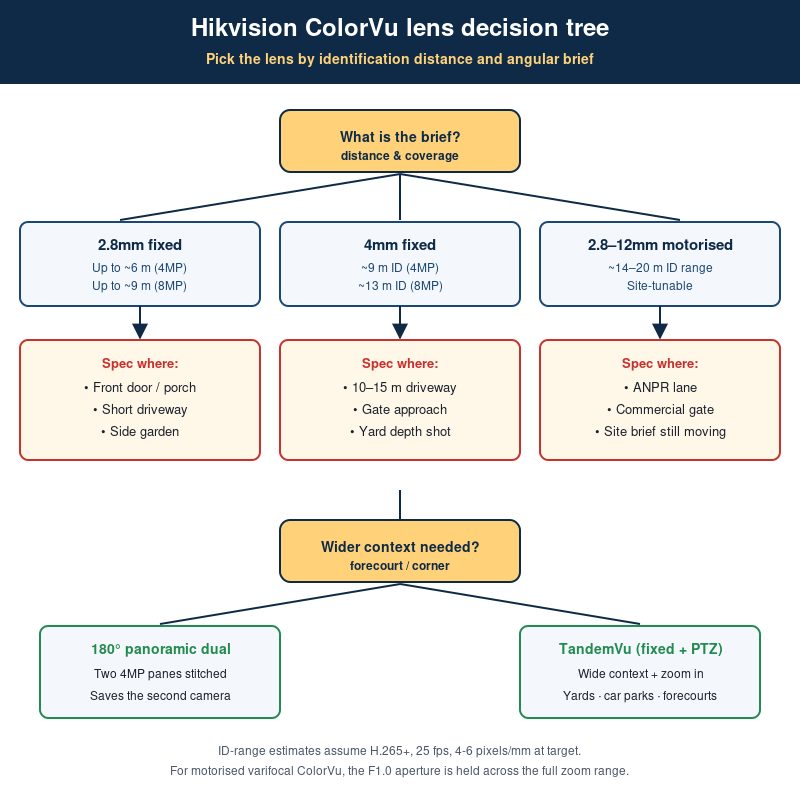
The lens-choice question is independent of the ColorVu generation, but ColorVu's wider aperture changes the practical depth-of-field a little — wider lenses become marginally more forgiving on focus. The standard installer rule: pick the lens that gives 4-6 pixels per mm at the identification target. For people, that is roughly 40 pixels across the face; for vehicles, 200 pixels across the plate.
| Scenario | Recommended lens | ID range (4MP) | ID range (8MP) | Why |
|---|---|---|---|---|
| Domestic front door / porch | 2.8mm fixed | ~6 m | ~9 m | Wide enough for the doorstep and the path |
| Short driveway / car parking spot | 2.8mm fixed | ~6 m | ~9 m | Wide angle keeps the whole car visible |
| Long drive / approach (10-15 m) | 4mm fixed | ~9 m | ~13 m | Tighter angle pushes ID further away |
| Commercial gate / ANPR lane | 2.8-12mm motorised | ~14 m | ~20 m | Lets you zoom-tune for plate capture |
| Forecourt / retail entrance | 180° panoramic dual | ~9 m (per pane) | ~13 m (per pane) | Two 4MP panes cover wall-to-wall |
| Side elevation / blind corner | 180° panoramic | ~9 m | ~13 m | Avoids the awkward two-camera-per-corner spec |
| Yard / car park with PTZ brief | TandemVu fixed + 25×/32× PTZ | n/a (situational) | n/a | Wide context + close detail in one chassis |
Bitrate, bandwidth and storage planning
ColorVu cameras are honest about bandwidth: they are bit-hungrier than equivalent IR cameras at night because the warm-light scene carries more noise and more colour entropy than a clean IR scene. Hikvision's bandwidth calculator tool recommends H.265+ at the maximum bitrate for ColorVu specifically — anything lower will smear motion in the warm-light fall-off zones. Industry baselines for 25 fps H.265+, scene-adaptive on:
| Resolution | H.265+ daytime | H.265+ ColorVu night | 30 days / cam (continuous) | 30 days / cam (motion) |
|---|---|---|---|---|
| 2MP (1080p) | 1.4 Mbps | 2.0 Mbps | ~550 GB | ~150 GB |
| 4MP | 2.2 Mbps | 3.5 Mbps | ~900 GB | ~240 GB |
| 5MP (3K) | 2.6 Mbps | 4.5 Mbps | ~1.1 TB | ~280 GB |
| 8MP (4K) | 4.0 Mbps | 6.5 Mbps | ~1.6 TB | ~430 GB |
Two practical implications. First, on motion-only recording, ColorVu still earns its keep at sane storage budgets — 4 × 8MP cameras at 30 days motion-only fits inside a single 2 TB HDD with headroom. Second, on continuous-record sites, plan for night-rate bitrate (the right column). The K-series AcuSense NVRs all handle the totals comfortably; we cover the sizing question in our AcuSense NVR sizing guide. The HiLook NVR side of the question is in HiLook NVR 4MP vs 8MP recording limits.
NVR compatibility — which recorder pairs with ColorVu
Every current Hikvision K-series AcuSense NVR supports ColorVu cameras and ColorVu-specific features (colour-night-mode banner overlay, AcuSense classification, warm-light supplemental control). The right pick is governed by channel count and per-channel decode budget, not by ColorVu specifically. For Turbo HD coax ColorVu cameras, the K-series DVR range is the standard pairing, with PoC support for the LSYE line.
Three practical pointers: (1) on ColorVu 3.0 cameras with HikAI-ISP and AcuSense 3.0, run the recorder on the latest firmware — older firmwares can suppress the AcuSense classification banner on playback. Our Hikvision firmware downloads hub tracks the current releases. (2) For mixed-brand or multi-site installs, run iVMS-4200 on a desktop and Hik-Connect for remote view — both support the ColorVu colour-night-mode banner natively. (3) The AcuSense and ColorVu features are complementary, not alternatives — they solve different problems and most modern installs use both at the same time. We explored the comparison in AcuSense vs ColorVu: which AI tech solves which site problem.
Site selection — where ColorVu earns its keep
ColorVu is the right answer when the scene has at least some ambient light at night (street lamps, security floods, neighbouring buildings, moonlight). The threshold quoted by Hikvision for ColorVu 3.0 is 0.0005 lux for colour with the warm light off — about a clear moonless night with no urban skyglow. Below that, the warm LED ramps up. Real-world UK applications where ColorVu has the strongest payback: dark forecourts and yards, retail and hospitality entrances, ANPR lanes, multi-let car parks, side elevations and gable ends, school perimeters and night-economy frontages.
Where ColorVu is the wrong call: covert perimeter zones where any visible light kills the brief, very dark indoor stockrooms with zero ambient light (an IR-only AcuSense camera is cheaper and equally effective), and listed-building façades where the customer cannot accept any external lighting fixture. In those cases pair a non-ColorVu AcuSense camera with a discreet IR illuminator. The Netview brands list covers the ancillary IR illuminators and PoE midspans you might need.
UK considerations — GDPR overspill, lighting bylaws, BS EN 50132
Two compliance points specific to ColorVu under UK practice. First, any external camera that lights up adjacent property — for example a ColorVu camera with a 30 m white-light reach pointed at a shared driveway — creates an "overspill" issue under UK GDPR (recording into a neighbour's curtilage) and potentially a statutory nuisance under the local council's lighting bylaw. Set the warm-light supplemental to Smart Hybrid Light rather than always-on, and aim the light cone within the customer's boundary. Second, BS EN 50132-7 (CCTV system design) still applies — ColorVu's better colour does not change the pixels-per-metre identification spec.
For commercial monitored sites, BS 8418 (detector-activated remotely-monitored CCTV) is the relevant standard. ColorVu plays well with BS 8418 because the colour image lifts confirmation reliability at the monitoring centre and the warm light counts as a confirmed deterrent action. For policing-by-light scenarios, the active-deterrent PIRXO cameras combine ColorVu with a red/blue strobe and audio — a one-camera answer to "the customer wants something that looks like a police response".
FAQ — installer questions answered
1. Does ColorVu still need a separate floodlight? Usually no — the integrated warm LED is enough for a doorway, drive or yard up to 30 m. On a very large car park or industrial yard, pair ColorVu with a low-lux floodlight rated for the area. The aim is to lift ambient to a level where the camera holds colour without firing its own LED.
2. Can I run ColorVu cameras on a non-Hikvision NVR? Yes, via ONVIF, but you will lose the ColorVu-specific OSD overlays, the warm-light schedule controls and the AcuSense classification banner on playback. The recommended pairing is a Hikvision K-series AcuSense NVR — see our AcuSense NVR sizing guide.
3. Is ColorVu 3.0 worth the upgrade over ColorVu 2.0? On a new install, yes — the up-to-130% light-sensitivity gain and HikAI-ISP are step changes, not marginal improvements. On a retrofit where the existing 2.0 cameras are still working, only swap them out at end of life or where the night-time motion blur is causing identification failures.
4. What lens should I pick for an ANPR lane? 2.8-12mm motorised varifocal, set to roughly 8mm for a typical 6-8 m capture distance. The varifocal ColorVu DS-2CD2747G2HT-LIZS is the right call because the F1.0 aperture holds at the long end of the zoom range.
5. How much extra bandwidth does ColorVu use compared to a standard IR camera? Roughly 30-60% more at night, depending on scene complexity. Plan for the right-hand "night" column in the bandwidth table above when sizing the NVR uplink and the customer's broadband.
6. Can I use ColorVu cameras in a fully covert install? No — the warm supplemental LED is visible. For covert perimeter use, spec a non-ColorVu AcuSense camera with a discreet IR illuminator.
7. Will a 4K ColorVu camera saturate an old 100 Mbps PoE switch? A single 4K stream at 6.5 Mbps is fine on any switch, but the recorder uplink is the choke point. On 8-16 channel 4K installs, run a Gigabit backbone — the Reyee PoE switch sizing guide covers the per-port and aggregate budgets.
8. What is the difference between ColorVu Smart Hybrid Light and a standard ColorVu warm-light camera? Smart Hybrid Light combines warm LED + IR + AcuSense-triggered light ramping in a single camera, so the warm LED only goes to full brightness when a person or vehicle is classified. Older standard ColorVu cameras hold the warm LED on continuously at a fixed level — fine when you want active deterrent, less neighbour-friendly when you do not.
Related posts and next steps
This hub is the canonical Netview ColorVu reference for 2026. For the related questions readers ask after reading a ColorVu page, follow these:
- Hikvision AcuSense vs ColorVu — which AI tech solves which site problem
- Hikvision AcuSense Complete Installer Guide 2026 — pillar reference
- Hikvision AcuSense NVR sizing — K-series, PoE and VPRO
- Hikvision 16MP vs 12MP Turret — when to spec each
- Reyee PoE Switch Sizing — 8/16/24-cam CCTV sites
If you would rather talk a spec through with a wholesaler, the Leicester sales line is 01163 800 838 — open 09:00-17:00 Monday to Friday. We hold the full ColorVu range in stock for same-day dispatch when the order lands before 16:30, and our trade accounts get next-day delivery as standard. Browse the full brand list at netviewcctv.co.uk/brands.
Last updated 11 May 2026. Article reflects ColorVu 3.0 specifications as published by Hikvision Global, October 2024 launch. Specifications, model availability and pricing subject to change.


About the Author


