

Hikvision Audio 2.0 Explained: Two-Way Audio, Mic Sensitivity & Site Selection


At a glance
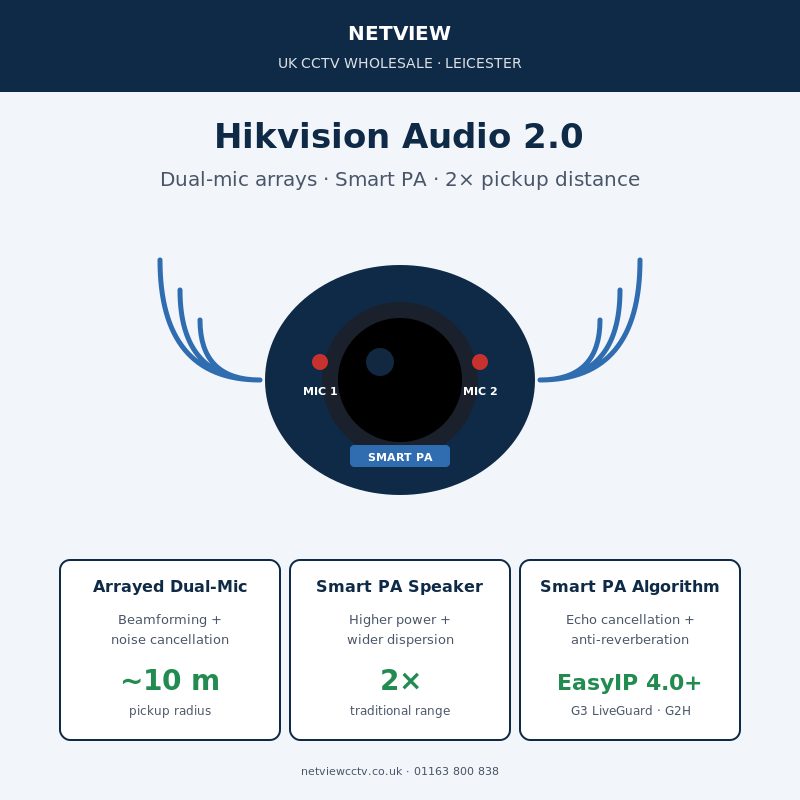
Hikvision Audio 2.0 is the second-generation audio platform that ships inside EasyIP 4.0 Plus cameras (the G3 LiveGuard range and the latest G2H Smart Hybrid Light cameras). It pairs an arrayed dual-microphone with a Smart Power Amplifier (Smart PA) speaker and a Smart PA algorithm, giving roughly twice the effective two-way audio distance of the previous single-mic generation, with built-in noise cancellation and anti-reverberation.
For UK installers it means clear two-way warnings from a single PoE camera at typical perimeter ranges (driveways, yards, car parks) without bolting on a separate horn speaker — provided you pick the right model and mount it correctly.
If you have specced a Hikvision LiveGuard or Smart Hybrid Light camera in the last 12 months, you have already deployed Audio 2.0 — but most installers do not know the platform by name. Hikvision lumped four new technologies into the EasyIP 4.0 Plus launch in October 2024: ColorVu 3.0, AcuSense 3.0, Motorization 2.0 and Audio 2.0. This guide pulls the audio side apart: what is genuinely new, which models actually carry it, where to mount the camera, and when you still need an external microphone.
Phone us on 01163 800 838 if you want a stock check or a quick spec sanity-check before quoting a job.
What is Hikvision Audio 2.0?
Audio 2.0 is the audio sub-system inside Hikvision's EasyIP 4.0 Plus Pro Series cameras. It is a hardware-and-algorithm upgrade with three named components: arrayed dual-microphone, Smart PA speaker and a Smart PA algorithm that handles noise reduction, echo cancellation and anti-reverberation. Hikvision's own launch material describes the audible improvement as "delivering clearer, louder voice and an effective distance equivalent to or greater than twice that of traditional" two-way audio (Hikvision Global, EasyIP 4.0 Plus launching event, 2024).
The point of the platform is to turn an off-the-shelf surveillance camera into an effective live deterrence and intercom endpoint — so a single LiveGuard camera at the front of a yard can do detection (AcuSense 3.0), full-colour 24/7 video (ColorVu 3.0 with Smart Hybrid Light), strobe warning, siren and a two-way voice challenge, without daisy-chaining a horn speaker like the DS-PA0103-B IP horn through a separate audio output.
What is new in Audio 2.0 vs first-generation two-way audio?
The biggest leap is the move from a single capsule mic to an arrayed dual-mic. Two capacitor microphones spaced inside the housing let the camera beam-form on the speaker, suppress wind and rain noise from off-axis directions, and run an anti-reverberation algorithm that strips the metallic echo you used to get from cameras mounted under soffits or canopies. Older single-mic cameras (the LiveGuard 1.0 G2 generation and earlier) typically picked up clear speech at about a 5-metre radius — the DS-2CE16D0T-LPXTS Turbo HD camera, for example, is rated for a 5-metre pickup radius (Hikvision spec sheet).
Audio 2.0 cameras (the G3 LiveGuard turrets and bullets and the new G2H Smart Hybrid Light range) push that figure to roughly twice the distance according to Hikvision's launch event. The Smart PA speaker side gets a matching upgrade: a higher-power amplifier with wider directional coverage and an algorithm that maintains intelligible voice broadcasts at distance instead of clipping into distortion (Hikvision Pro Series with ColorVu 3.0 product page).
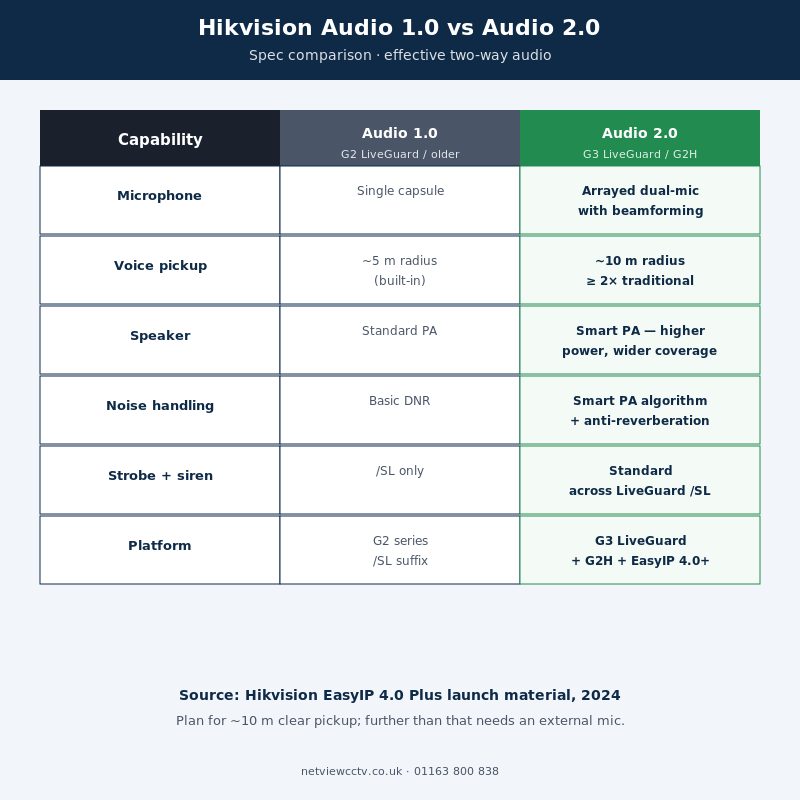
Audio 2.0 vs first-generation: spec comparison
| Capability | Audio 1.0 (G2 LiveGuard / older) | Audio 2.0 (G3 LiveGuard / G2H) |
|---|---|---|
| Microphone | Single capsule | Arrayed dual-mic with beamforming |
| Effective voice pickup | ~5 m radius (built-in) | ~10 m radius — "≥ 2× traditional" |
| Speaker | Standard PA | Smart PA — higher power, wider coverage |
| Noise / echo handling | Basic DNR | Smart PA algorithm — noise cancellation + anti-reverberation |
| Strobe + siren | On /SL models only | Standard across LiveGuard /SL range |
| Typical platform | G2 series, /SL suffix | G3 LiveGuard, G2H Smart Hybrid Light, EasyIP 4.0 Plus |
Which Netview SKUs carry Audio 2.0?
Look for the LiveGuard suffix pattern: /SL at the end of an EasyIP 4.0 Plus part number indicates the strobe-light variant with the full LiveGuard 2.0 stack (mic, speaker, strobe, siren). Models without /SL still have the dual-mic and Smart PA speaker, just without the white strobe.
In-stock examples on netviewcctv.co.uk:
- Hikvision DS-2CD23166G3-IS2UY/SL (2.8 mm) 16 MP LiveGuard turret — the flagship 16 MP G3 with full Audio 2.0 + LiveGuard 2.0.
- Hikvision DS-2CD2087G3-LI2UY/SL (2.8 mm) 8 MP G3 LiveGuard turret — same platform at 8 MP, the most common spec on UK domestic / SMB jobs.
- Hikvision DS-2CD2047G3-LI2UY (2.8 mm) 4 MP G3 ColorVu turret — entry-level G3 with Audio 2.0, no strobe.
- Hikvision DS-2CD2347G3-LI2UY (2.8 mm) 4 MP G3 Smart Hybrid Light turret — Audio 2.0 + Smart Hybrid Light, no strobe.
- Hikvision DS-2CD2387G3-LIS2UY/SL (2.8 mm) 8 MP G3 LiveGuard turret — the popular 8 MP perimeter turret.
- Hikvision DS-2CD2T87G3-LIS2UY/SL (2.8 mm) 8 MP G3 LiveGuard bullet — bullet form-factor for long driveways and side returns.
- Hikvision DS-2CD2T47G3-LIS2UY/SL (2.8 mm) 4 MP G3 LiveGuard bullet — 4 MP perimeter bullet, same Audio 2.0 platform.
- Hikvision DS-2CD2647G3-LIZS2UY/SL 4 MP varifocal LiveGuard bullet — for car parks where you need motorised zoom plus voice challenge.
- Hikvision DS-2CD2346G3-IZS2UY/SL motorised 4 MP G3 turret — motorised lens variant.
- Hikvision DS-2CD2386G2H-IS2U/SL (2.8 mm) 8 MP G2H Smart Hybrid Light turret — the G2H Smart Hybrid Light platform that introduced Audio 2.0 alongside the G3 series.
- Hikvision DS-2CD2T86G2H-IS2U/SL (2.8 mm) 8 MP G2H Smart Hybrid Light bullet — bullet sibling, same audio stack.
Microphone sensitivity and pickup distance — what to expect
Built-in camera microphones are still capsule devices in a sealed IP67 housing, so the laws of physics still apply. As a working rule for Audio 2.0 cameras, plan for clear speech capture out to about 10 metres in a normal acoustic environment, dropping off quickly past that. Wind, traffic and reflective surfaces (steel shutters, brick alleyways) all knock it back even with the noise-cancellation algorithm running. Real-world testing of older single-mic Hikvision cameras backs the original 5-metre pickup figure (Use-IP IP-CCTV community testing), and Audio 2.0 doubles that without changing the underlying physics.
If you need wider, cleaner room pickup — for reception desks, interview rooms, classrooms — the external mic still wins. The Hikvision DS-2FP4021-B digital-noise-reduction microphone picks up a 360° area at ~10-metre radius with adaptive noise cancellation (Hikvision US technical bulletin), and the Hikvision DS-2FP2020 Hi-Fi condenser microphone covers roughly 70 m² at 360°. Both run off the camera's audio-in jack — they do not replace Audio 2.0, they complement it where you need omnidirectional pickup at a fixed indoor location.
How to choose: built-in Audio 2.0 vs external microphone
Use built-in Audio 2.0 when the same camera is doing detection + deterrence + voice challenge from the same mounting position — a yard, driveway, loading bay, car park or shop frontage. Use an external mic when you specifically need indoor speech recording at a fixed point (reception, till area, classroom) regardless of the camera's mounting position. Sometimes both: an Audio 2.0 LiveGuard at the gate plus a DS-2FP4021-B inside the office.
Where to mount an Audio 2.0 camera for best results
Site selection drives 80 % of perceived audio quality. The headline rule: mount the camera so the speaker faces the area you want to talk to, not back into a wall or canopy. The arrayed mic and Smart PA work in the same plane, so a clean line-of-sight to the subject from the camera face matters more than absolute distance.
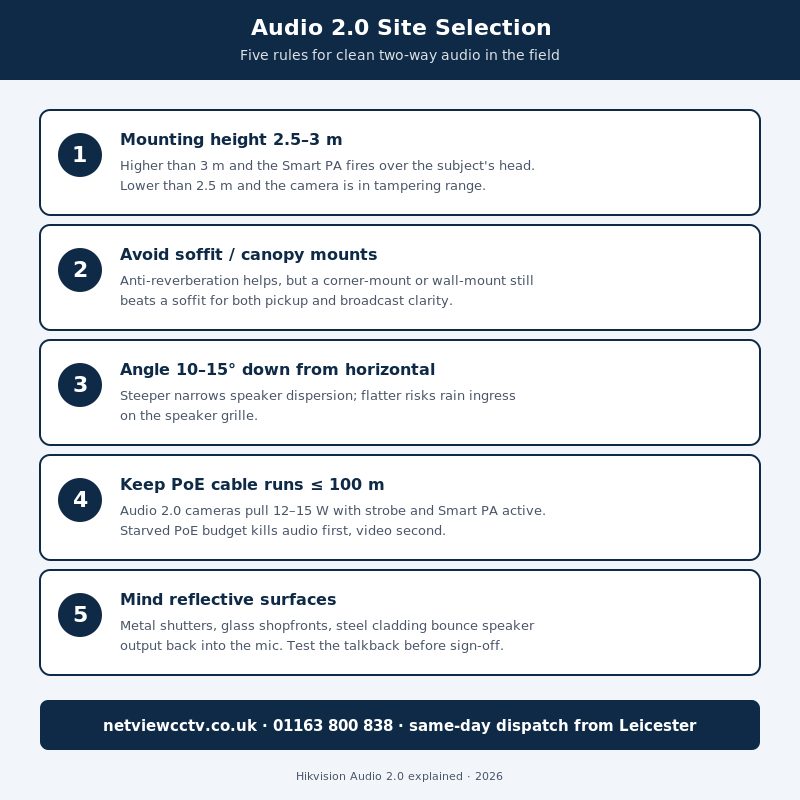
Five practical rules for UK installs:
- Mounting height 2.5–3 m. Higher than 3 m and the speaker fires over the head of the person you are challenging; the mic also picks up more wind noise.
- Avoid soffit / under-canopy mounts where you need clean audio. The anti-reverberation algorithm helps, but a corner-mount or wall-mount still beats a soffit for both pickup and broadcast clarity.
- Angle 10–15° down from horizontal. Steeper and the speaker dispersion narrows; flatter and rain ingress increases on the speaker grille.
- Keep cable runs ≤ 100 m on PoE. Audio 2.0 cameras typically pull 12–15 W with strobe and Smart PA active, so a starved PoE budget kills audio first, video second.
- Mind reflective surfaces. Metal shutters, glass shopfronts and steel cladding bounce speaker output back into the mic. The algorithm handles indoor echo well; outdoor flutter echo off a corrugated unit is harder. Test the talkback before signing off.
NVR and platform compatibility
Audio 2.0 cameras stream G.711a / G.711u / G.726 / AAC over RTSP exactly like older Hikvision cameras, so any current AcuSense NVR records the audio channel alongside the video stream. We typically pair them with the Hikvision DS-7608NXI-K1/8P(D)/Alarm4+1 AcuSense NVR on small jobs, the DS-7716NXI-K4(D) 16-channel on mid-size sites, and the DS-7732NXI-K4(D) 32-channel or VPRO variants on larger sites — see our AcuSense NVR sizing guide if you need to size by channel count.
For two-way push-to-talk from iVMS-4200 or Hik-Connect, the camera and the client both need to be on the latest firmware. Our iVMS-4200 installer guide walks the live-view talkback workflow, and the Hik-Connect installer handover guide covers customer-side talkback on phones and tablets.
Audio 2.0 vs Hikvision TalkVu and external IP speakers — when to use which
Audio 2.0 is a camera-side feature — voice challenge, intercom-style "can I help you" prompts, ad-hoc talkback. It is not a replacement for the Hikvision TalkVu video intercom range (DS-KV6114-WBE1 door station, DS-KH8381-WTE1 indoor monitor, DS-KIS613-S kit), which is the right answer when you need a doorbell, call routing, mobile answering and unlock control. And it is not a replacement for a dedicated IP horn speaker like the Hikvision DS-PA0103-B IP horn, which still wins for large public-address coverage and pre-recorded broadcast — the typical school PA or factory shift-end announcement.
FAQ — installer questions on Audio 2.0
Does every G3 LiveGuard camera have Audio 2.0?
Yes. Every EasyIP 4.0 Plus G3 LiveGuard and G2H Smart Hybrid Light camera carries the dual-microphone and Smart PA speaker. The /SL suffix adds the strobe; the underlying audio platform is the same.
What is the actual pickup distance of an Audio 2.0 camera?
Plan for clear speech capture out to about 10 metres in a quiet environment, dropping to 5–6 metres in wind or busy traffic. Hikvision's launch material claims "≥ 2× the traditional" pickup distance.
Do I still need an external microphone like the DS-2FP4021-B?
Only if you need clean 360° pickup at a fixed indoor point (reception desk, classroom, interview room). For outdoor perimeter audio, the built-in Audio 2.0 mic is usually enough.
Can I push a pre-recorded warning from Hik-Connect?
Yes — the Hik-Connect app supports custom audio prompts on LiveGuard cameras, triggered by an AcuSense detection event or manually. Push-to-talk live audio is also supported on iOS and Android.
Will Audio 2.0 work with my existing Hikvision NVR?
Yes. Audio is carried in the RTSP stream and recorded alongside video. Any current AcuSense NVR firmware records the audio channel. Older non-AcuSense DVRs may need a firmware update.
Is there a UK legal restriction on recording audio?
The ICO's CCTV code of practice treats audio recording as more privacy-intrusive than video and requires a strong, documented justification. Disable audio recording on perimeter cameras and only enable it where you can show a specific reason (typically intercom-style talkback, not continuous recording).
Need a stock check or spec sanity-check?
We hold the G3 LiveGuard and G2H Smart Hybrid Light ranges in our Leicester warehouse for same-day dispatch to UK installers. Call 01163 800 838 to confirm stock on a specific lens variant or to order a sample for testing on a live site. Trade accounts get next-day to most UK postcodes.
Published 20 May 2026 · Last updated 20 May 2026 · Netview Leicester · 01163 800 838 · For UK CCTV installers


About the Author


